
What Teaching Seniors Taught Me About Yoga

Updated: May 17
There is a moment I return to often.
I was teaching a class with a group of seniors — ages ranging from 62 to 78. One student, a retired schoolteacher, had told me before class that she hadn't moved her body intentionally in over three years. She sat on her mat with a kind of polite uncertainty, as though she wasn't sure she belonged there.
By the end of that hour, something had shifted. Not dramatically — she didn't suddenly touch her toes or float into a balance pose. But her shoulders had dropped. Her face had softened. She looked at me afterward and said: 'I forgot I had a body.'
That sentence has never left me.
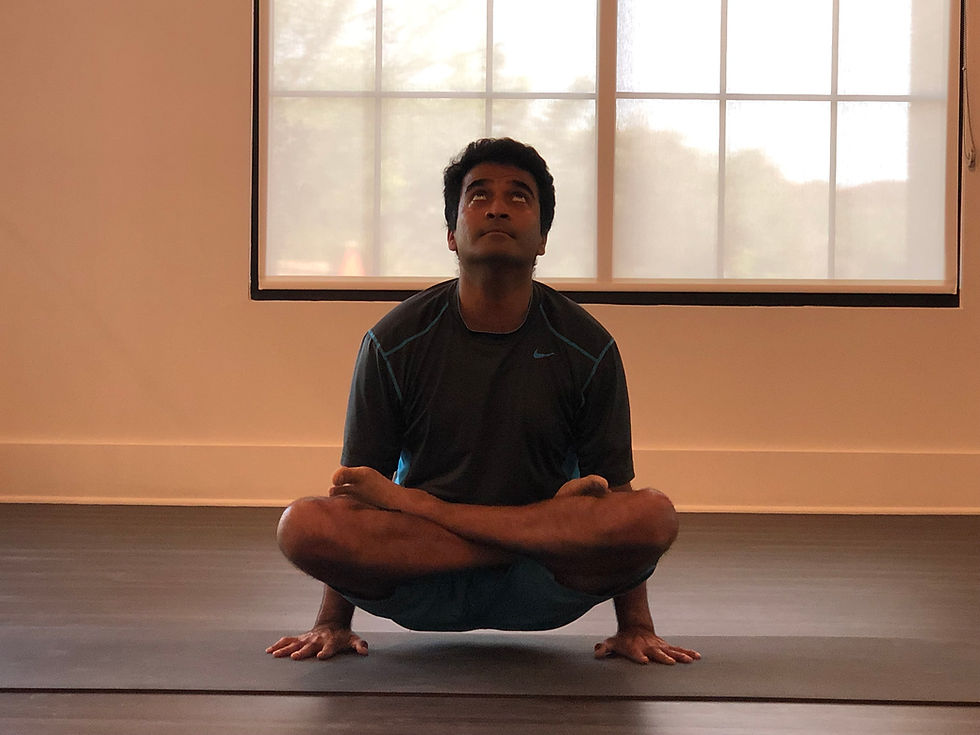
What teaching seniors taught me
I came to teaching seniors expecting to give. What I found was that I received more than I gave.
Working with older bodies — bodies that carry decades of history, injury, resilience, and wisdom — deepened my understanding of yoga in ways that no training manual ever could. I learned that the practice isn't about what the body can do. It is about what the body is allowed to feel.
The anatomy is different. A 70-year-old hip joint has less synovial fluid than a 30-year-old one. The connective tissue is less elastic. The nervous system responds more slowly. Balance is affected by changes in the inner ear and proprioception. None of this means the practice is diminished — it means the practice must be different.
This is where the Indian tradition of the guru-student relationship becomes not just culturally relevant, but practically essential. You cannot teach 15 people over 60 the same way you teach 15 people in their 30s. Each person needs to be seen. Each body needs to be heard.
What changes — and what never does
What changes: the depth of a forward fold, the height of a balance pose, the pace of transition between movements. A Warrior I that a younger student holds for 10 breaths may need to be held for 3, then slowly built over weeks.
What never changes: the breath. The intelligence of the nervous system. The capacity for stillness. The body's deep desire to be treated with care.
I use props extensively when teaching seniors — not as a concession but as a celebration. A block under the hands in Triangle Pose is not a limitation. It is the pose meeting the person exactly where they are. A bolster under the knees in Savasana is not laziness. It is the body finally receiving the support it has needed all day, all week, perhaps all year.
This is what Patanjali meant by Sthira Sukham Asanam — steady and comfortable. Not modified for weakness. Adapted for wisdom.
The acceptance that changes everything
The most profound shift I see in senior students is not physical. It is the moment they stop apologising for their bodies.
So many older adults walk into their first class carrying years of 'I used to be able to...'. Used to be able to run. Used to touch my toes. Used to feel strong. The body they have now feels like a lesser version of something they've lost.
Part of what I try to offer — and what yoga genuinely provides, when taught well — is a reframe. This body, right now, is not a lesser version of anything. It is exactly the body that has carried you through everything you have lived. It deserves not frustration but gratitude.
When that shift happens — and I have seen it happen, slowly, in class after class — the practice opens in ways that no amount of flexibility could create.
An invitation
If you are over 60 and you have been telling yourself that yoga is not for you — I want to respectfully disagree.
If you have had a hip replacement, a knee surgery, chronic back pain, or simply haven't moved intentionally in years — you are not disqualified from yoga. You are exactly the person yoga was designed for.
At YogaStayFit, every class is taught with your body in mind. Modifications are not an afterthought — they are part of the instruction. Props are offered before they are needed. The pace is your pace.
You don't need to remember what your body used to do. You just need to arrive.
— Raj Krishnamoorthy, RYT | yogastayfit.com


Comments